
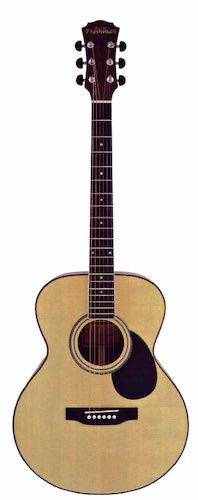
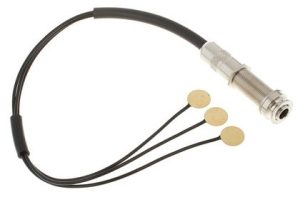
I fitted a K&K Pure Mini pickup to my Guitar, a Freshman FA350FBF quite a few years ago. I have struggled to get a reasonable sound from it. I was loth to buy the recommended K&K preamp, which, when I Googled it, just seems to be a high Z input amp with a standard tone control.
I’m a retired electronic engineer, and when I read this in the product manual I immediately thought “Snake oil”:-
“The Pure Preamp is manufactured using K&K’s “full size” component philosophy. We are convinced that most miniature components do not provide the best possible sound quality. We use only top quality through-hole capacitors for exceptional dynamic, depth of field and highest resolution.”
And the technical data is just sloppy.
TECHNICAL DATA
Frequency response: 10 – 30,000 Hz Input 1/4″,
10Hz? Lowest frequency from a Bass guitar is 40Hz and humans can only hear down to 20Hz
1 Mega Ohm Output: 1/4″,
No, I dont think so. It’s probably 100ohms – only a factor of 100 out. Or maybe it means input?10 KOhm Bass: roll off @100Hz
No idea what “10 KOhm Bass” meansMidrange: super wide band @1.5kHz Treble: 10Khz
Size: 2 ½” x 3”
Battery Consumption: less than 1 milli Ampere – 9-volt – 180 hours
So I did a few measurements on the pickup.
It outputs around 2 volts p-p into an open circuit with a hard strum.
It measures 25nF capacitance.
Feeding this into a 1M input impedance, as recommended, gives a frequency response down to 6Hz! The bass will need to be cut in the EQ, although most will be taken out by the mixer’s LF roll-off.
Feeding into a 10K input, as in a typical PA gives a response down to 600Hz – the bass needs to be amplified in the EQ.
Now the conventional wisdom is that the K&K MUST feed into high impedance (or rarely into zero impedance as in a charge pump). But I decided to try a different approach. I made the K&K feed into a 4.7uF capacitor. This dropped the output voltage by a factor of 200, to around 5mV. It also dropped the output impedance by the same ratio. This is a typical microphone level. Then I added a 330R resistor which makes it look like a dynamic mic. The low frequency 3dB is now around 100Hz
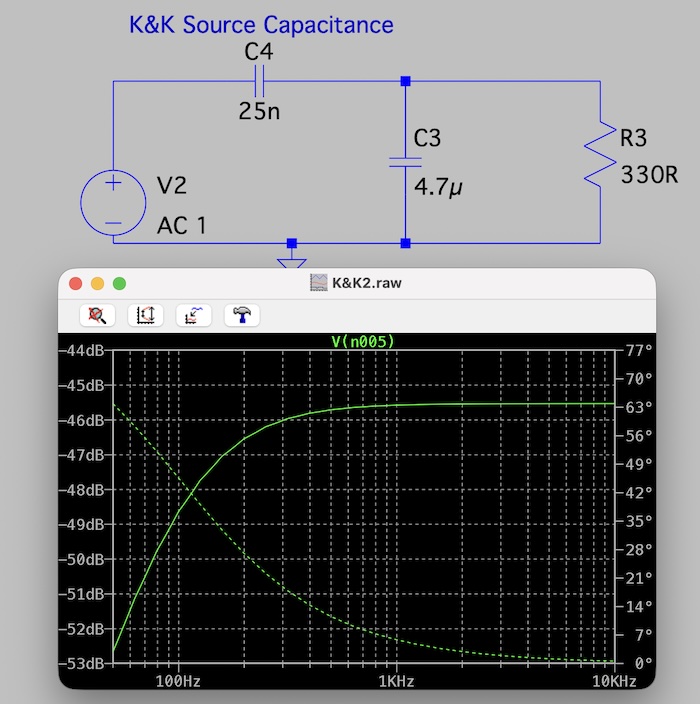
I added the components in the jack plug in a marked cable.
Feeding this into my mic preamp gets me the best sound I have ever got from the K&K. A little EQ to suit the amp and the room makes it sound wonderful.
I have also made up a jack to XLR connector with the components fitted in the XLR to easily plug into a PA or mixer mic input.
Does it sound like an external mic?
No, the external mic picks up the sound radiated by the soundboard. The body modes are strongly damped by that radiation, so the initial burst dies away quickly. The piezo senses string force at the saddle, and the string itself decays slowly. The mic sounds more percussive and alive, and the K&K sounds smoother and more even.
What I have learned from this:—
- A guitar will always sound different when heard through a mic or a pickup. Not necessarily better, just different.
- With a guitar with a beautiful acoustic tone like my Freshman, you will probably favour the mic. With other guitars, like my Martin LXME, you may feel they are better plugged in.
- It is probably best to look upon your guitar playing acoustically, and plugged in as two different instruments and not get hung up on them sounding the same (like I have been)