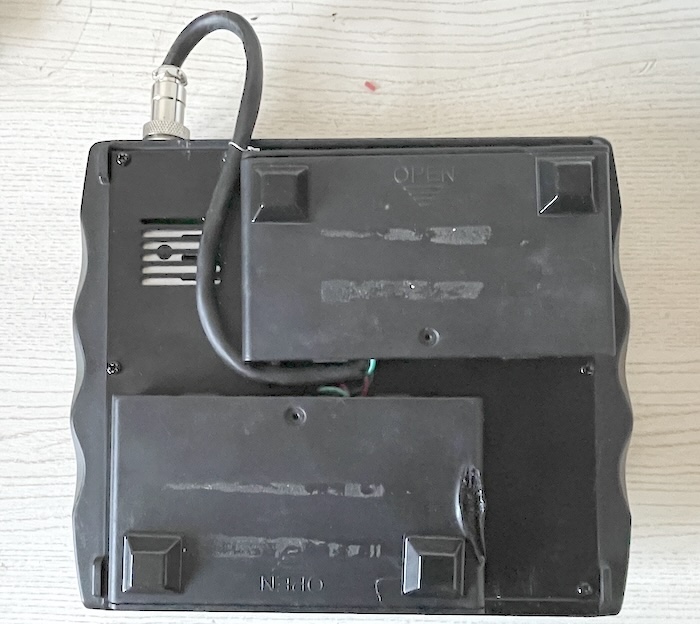
The Wharfdale mixer
The feasibility of running this mixer designed for mains use was covered in a previous post. In that article I ended up running the mixer from PP3 batteries connected in pairs to give +/-9V. I had ascertained that the mixer could run down to +.-7V and all that would be affected is the maximum output signals and the level that the LED indicators switch on.
BUT I am a worrier! The PP3s are fine, and should last 7-8 hours. But I would have to keep a track on how long they had been used, carry a spare set, and maybe a meter to measure them. This is fiddly to say the least.
Using AA Batteries
So I decided to repurpose my trusty old eneloops. Even the worst ones according to my tests will do 1000mAH, just like the the PP3’s but they can be recharged prior to, and after the gig. No spares needed and no meter.
Eneloops will maintain 1.25V for most of their discharge time so 8 batteries will give me at least 10V.
It has been four years since the last tests so I decided to test them again. Basically:-
Charge ‘em up
test
Pick best 8 for +10V side and next best 8 for -10V.
Test Results
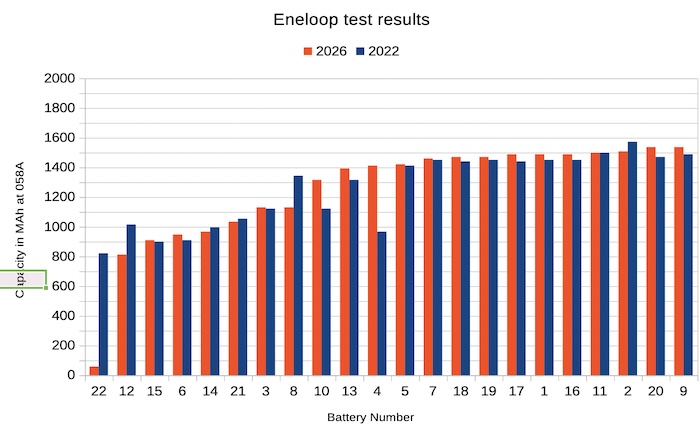
The chart shows the results of the latest tests are described in my previous article and compares the results from those tests. Number 22 battery looks to be defunct now. I tried to revive it with a few charges and discharges and got it to 480mAh, but I would not trust it now (a shame, it’s only 21 years old as well!)
But I will be using the eight batteries from 19 to the right for my +10V bank and the eight from 18 to leftwards to 3 for my -10V bank. The overall capacity is defined by battery 3 which worked out at 1131mAh. The tests were done with a load current of 580mA. The mixer takes 88mA from the negative rail. At this lower current the lifetime will be around 10% longer so I can expect an operating time of around 12-13 hours from a set of fully charged batteries.
Testing took a while – around 2hrs per battery. While they were testing I decided to check out how much the lower voltage affected the LEDs.
Testing the Wharfdale
On standard power supply
The first tests were made with the mixer powered in the usual manner with the mains transformer. I got a few surprises!
The maximum output, according to the specifications is 21dBu which is around 24V p-p. I measured with an oscilloscope and found clipping at -5 and +8V. So maximum undistorted output is 10Vp-p or 13dBu
The level meter according to the specifications is a 4-Segment LEDx2 (output of +4dB = 0). The oscilloscope revealed that 0 was actually -4.9dBu
Other than that, the “-20” was only 14dB down on the “0”, the “6” was indeed 6dB higher than the “0” and clipping indication was 17dB above “0” 1.5dB below actual clipping. There is 18dB headroom on the “0” setting.
Now none of the “variances” affect the operation of the mixer and it works well, but it was good to get a starting point to see the effects of my power supply change. In practice, we won’t need much headroom anyway.
On +/- 9V Battery bank
The maximum undistorted output dropped to 7.8V p-p or 11dBu, not a big change from 13dBu with the transformer,
The level meter’s “o” was now -11.9dBu. All of the other readings maintained the same ratio to the new “0” but now there was 6db of overhead between actual clipping and clipping indication. There is 22dB headroom on the “0”setting.
So basically, all the level setting have dropped by a bit over half. This suggests that the power supply inside the mixer has dropped from a probable +/-15V to around +/-7V.
On the Eneloop +/-10V Battery bank
I measured the current taken this time and it was 98mA from the positive supply and 88mA from the negative supply. So I should be able to get over 12 hours runtime before recharging.
The maximum undistorted output is 10Vp-p – the same as with the mains transformer. The “0” level is now at 10dBu.
Construction
I decided to up my game a bit, Sticking the PP3s to the base is quick, easy, and functional. But not really suitable for a “proper job”. So I recycled two old AA battery cases that had once been used in my busking amp.