
A Box for the Busking Amp

I made this DIY busking amp from an old guitar practice amp. All I needed was the box and the speaker. Any old amp would have done, although the speaker had to be able to handle over 7.5 Watts. I had a Vox DA5 which comes with a 10W speaker

I removed the electronics leaving on the speaker and the enclosure. I screwed a reinforcing block on the bottom with a hole so I could mount the box on a mic stand. Mic stands are bad enough to carry about, but speaker stands are out of the question. In practice a chair or a wall, or even simply the ground will work, the rear panel can be opened and the amp tilted up, but a stand gives more projection. I added a separator board as cables and mics can be stuffed inside the box and I did not want them hitting the electronics.
The Amp


To get the power, I bought a Class D Amp. from Amazon. It cost me £7.74 (in 2019) The amp is capable of providing 30 Watts (15+15) into 8 ohms with a 24V supply. It is sold as PAM8620 although that is actually the ID of the chip. It is sold by lots of Chinese suppliers Although it is a stereo amp I only use one channel, and a 12V supply. The amp is specified to drive to within a volt of the rails or which gives about 7.5 Watts into an 8 ohm speaker from a 12Volt supply. It has a volume control and I found it could reach max power with only 0.7Vp-p at the input with the volume turned up full giving it a max gain of 40 (or 32dB). The potentiometer is used to mount the amp to the replacement top panel.
A gain of 40 was not quite enough to get the maximum volume from the amp using the balancing mixer which has a gain of 100 with the balance control centred so I added a little x4 amplifier built on Veroboard using an opamp, before the PAM8620. So the maximum gain is 100 x 4 x 40 and the Busking amp will peak out with a 1.4mV input from the mics or instruments.
In practice the gain will be set lower than this to give reasonable headroom.
NOTE;- I don’t think the x4 was really needed, especially since I wired in the EQ700 (see below) which can add 15dB or x6 gain if needed.
The Power
 I have tried a few different power supply solutions, including C cells, Alkaline AA cells and rechargeable AA cells. I currently use a Lucas 2.3AH 12V lead acid Battery which cost me £14.95 from ebay. My logic is:-
A lead acid battery can be charged while still in the amp with either my Ctek car battery charger or in the car via the cigar lighter socket. So it can be charged easily in between gigs. The battery is 2.3Ah and if I discharge it to 50% that is 1.15Ah or 13.8Wh. The amp can give 7.5W peak, but in normal operation it will only be taking around 3 watts. So four hours continuous playing is no problem.
In an emergency, the lead acid could go further if I allow it to discharge to under 50%. This is not good for a lead acid battery but it should only happen very occasionally, if at all.
EQ
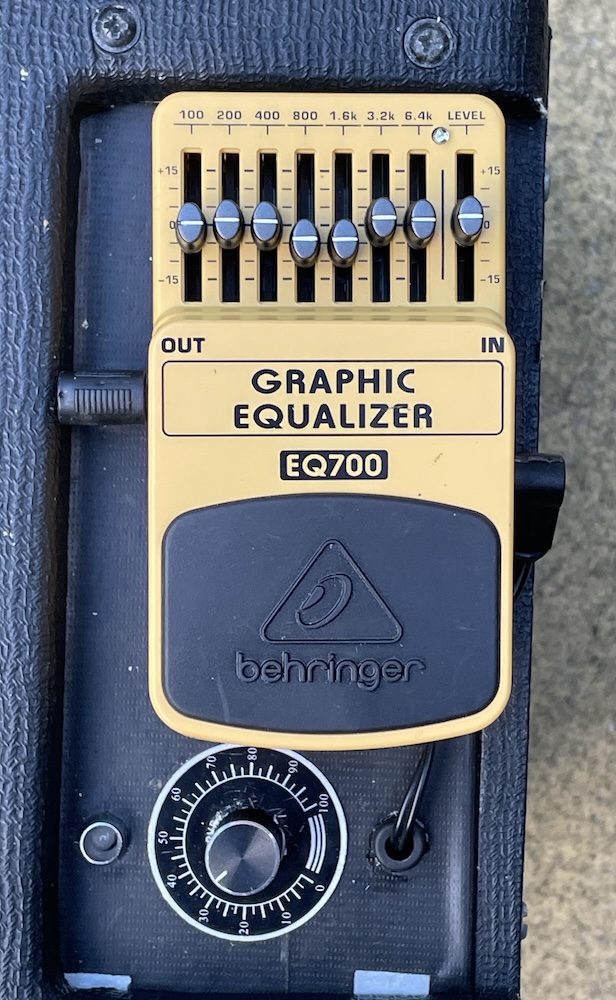
The amp sounds pretty good with no EQ, but I found, using my Behringer EQ700 (£19.30 from Amazon), that a dip at 800Hz and 1600Hz improved it further. So I decided to attached the Behringer to the box. This gives me the ability to use the EQ to reduce feedback at troublesome frequencies. (Despite only being 7.5W I find that feedback howl, not power is what usually limits the maximum sound I can use) I fitted a regulator inside the box to power it from the Amps battery. This avoids having to remember to unplug the input to the Behringer, which is the only way to switch it off.
I dropped the output of the EQ box through a hole drilled in the top plate and connected in to the old input socket. (the new input socket is the one on the EQ700). This turns the old input socket into an output and can go to another amp, so the busking amp can be used as a monitor.
The Final DIY Busking Amp
I usually drive the amp from my balance orientated mixer.
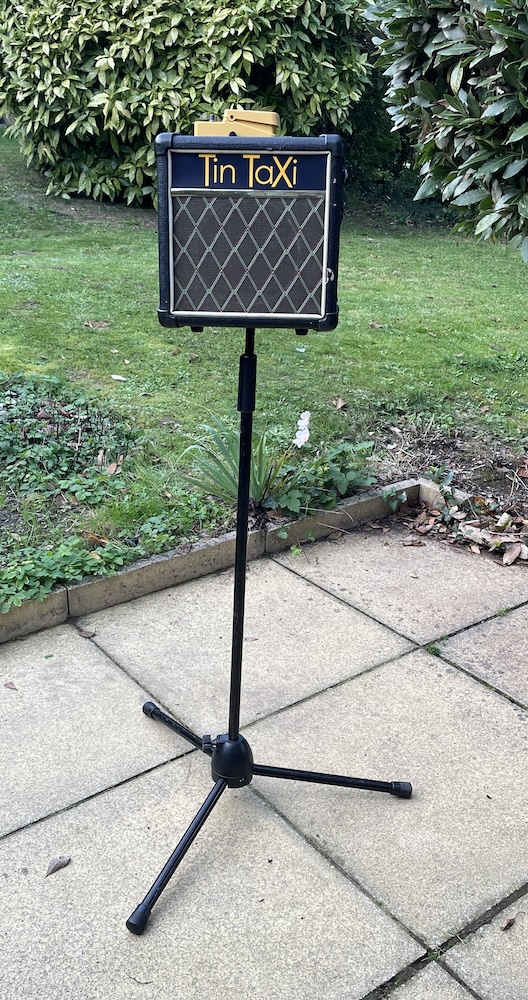
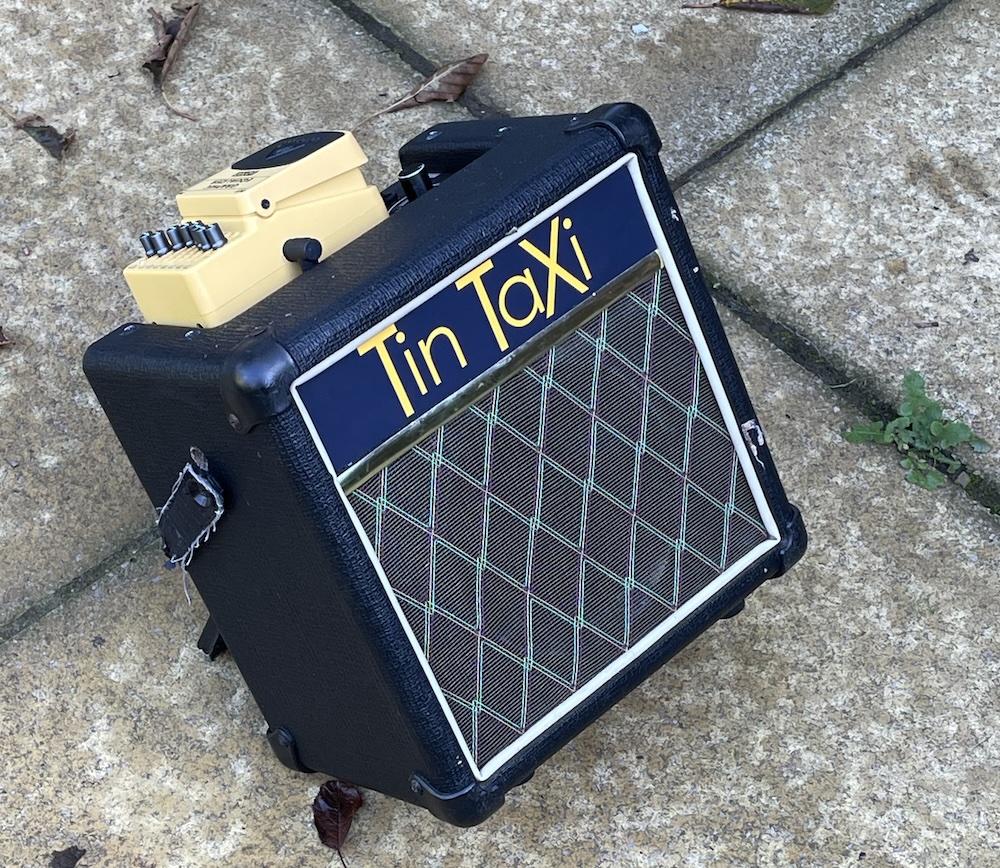
It weighs 4.3Kg (or 9.5 pounds), so not too heavy.
Why a DIY busking amp
You can buy a busking amp for under £200, but if you can come by an old non-working guitar amp, you can make this for around £30. You can use any batteries you like, even run it from your car battery.
This amp only has one input. If you need more, then the MX400 or any battery driven mixer will work fine, with or without my modification. (I use my balancing mixer) It could be powered by whatever you use the power the amp.
Music need not be your only creative outlet.
Afterword
It works well.
Is 7.5 watts enough? Maybe you’d like it to be twice as loud? So 15 watts? NO!
Doubling the electrical power sent to a speaker increases the sound pressure level by a modest +3 dB, which is perceived by the human ear as only a very slight or barely noticeable increase in volume. See explanation here
Sound is measured in Decibels. The old value was bels (where a decibel = 1/10th of a bel). You need an extra bel to sound twice as loud. That requires 10x the power or 75 watts. This assumes a similar sensitivity speaker.
Anything between 3 watts and 10 watts is easily loud enough for busking or a small venue and this diy busking amp works for me.
Disclaimer:- These are my solutions, they may not suit everyone but maybe they will generate some ideas.